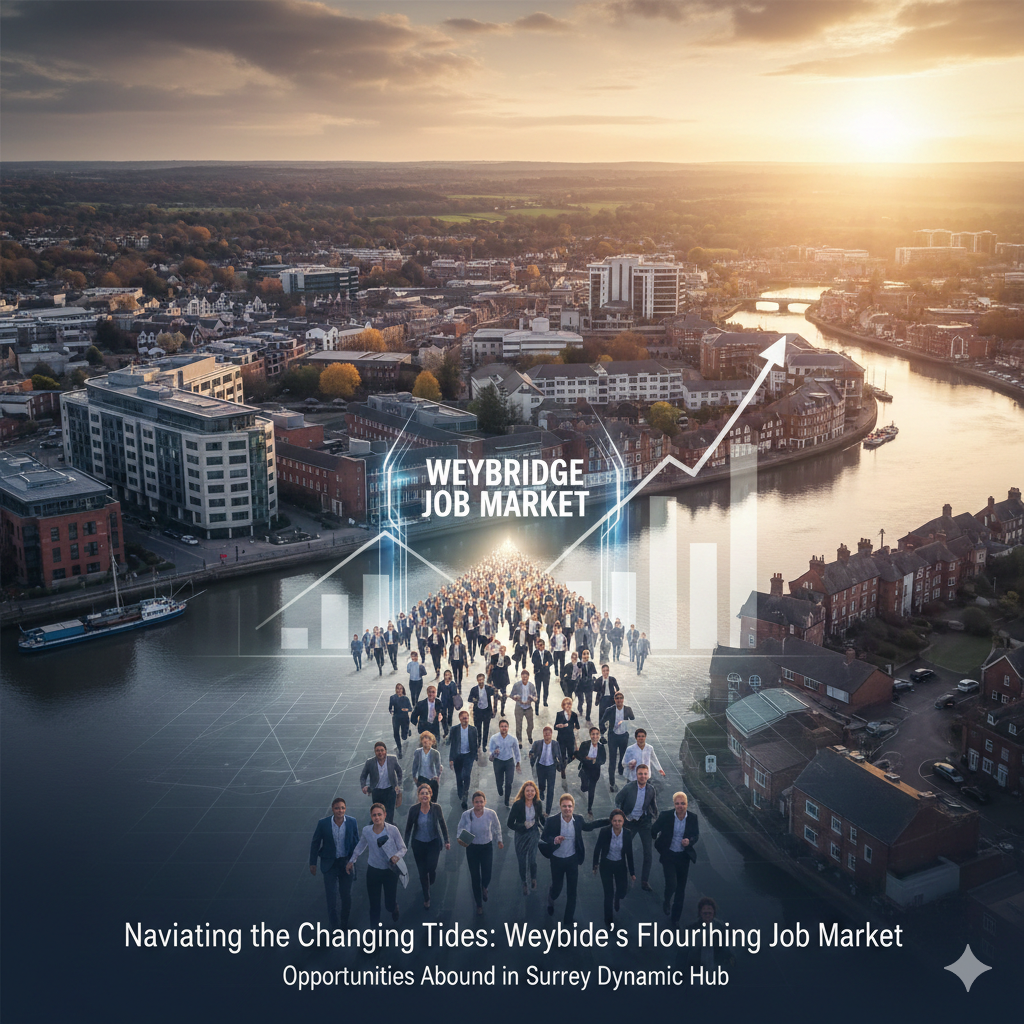
Weybridge, Walton-on-Thames and Molesey sit at the heart of one of Surrey’s most resilient and desirable business locations. Together, these towns form a significant part of Elmbridge Borough, an area that continues to attract employers thanks to its proximity to London, strong transport infrastructure and a highly skilled resident workforce. As we move through 2026, the question for local businesses is how to secure and retain talent in an increasingly competitive environment.
Employment levels remain high as the labour market tightens
Elmbridge continues to demonstrate strong labour-market performance. According to the Office for National Statistics, the employment rate for residents aged 16 to 64 stands at just over 76 percent, comfortably above the UK average. Unemployment remains low at approximately 2.6 percent, although this has edged upwards slightly in line with national trends. The claimant count, measuring residents receiving job-seeker related benefits, currently sits at around 2.2 percent of the working-age population.
For employers, these figures point to a labour market that is effectively operating close to capacity. While this reflects a healthy local economy, it also means fewer immediately available candidates and greater competition for individuals with in-demand skills. Recruitment timelines are lengthening, and businesses are increasingly competing not just on salary, but on flexibility, culture and long-term progression.
Key industries driving local demand for talent
The structure of the local economy plays a major role in shaping recruitment needs across Weybridge, Walton and Molesey. Professional, scientific and technical services are particularly prominent, especially around Weybridge and the Brooklands area. Economic data published by Elmbridge Borough Council highlights these sectors as among the fastest growing locally, supported by a resident population with higher-than-average qualification levels and professional experience.
Wholesale and retail trade remains the single largest employment sector by job numbers. Walton-on-Thames and Molesey continue to support a strong mix of independent retailers, service businesses and consumer-facing employers. While these sectors have faced rising costs and staffing pressures, local spending power has helped sustain demand for customer service, management and operational roles.
Logistics, light industrial and distribution roles form another key pillar of employment. Brooklands Industrial Park and surrounding commercial zones account for a significant proportion of Elmbridge’s employment floorspace, with Weybridge alone holding close to half of the borough’s office and distribution capacity, according to the council’s most recent Employment Land Review.
Commuting, hybrid working and changing candidate expectations
One of the defining characteristics of the local workforce is commuting behaviour. A substantial proportion of residents travel outside Elmbridge for work, most commonly into London. At the same time, hybrid and remote working patterns introduced in recent years have become firmly established. For many candidates, flexibility is now a baseline expectation.
This shift has created both challenges and opportunities for local employers. Businesses that offer hybrid working, flexible hours or reduced commuting requirements are often able to attract candidates who might otherwise prioritise London-based roles. At the same time, employers without flexible arrangements may find themselves competing for a smaller pool of available talent.
A business landscape dominated by SMEs
Elmbridge’s economy is driven predominantly by small and medium-sized enterprises. Surrey economic data shows that the majority of local employers fall into the micro and SME category, rather than large corporates. This creates consistent, ongoing recruitment demand across a wide range of roles, from entry-level positions to experienced specialists and senior managers.
For SMEs, recruitment decisions tend to be particularly high-impact. Hiring the right person can accelerate growth and stability, while the wrong hire can place pressure on time, budgets and team performance. As a result, many businesses are placing greater emphasis on cultural fit and retention rather than simply filling vacancies quickly.
What this means for employers in 2026
Weybridge, Walton and Molesey continue to be strong places to do business in 2026, but hiring is becoming noticeably tougher.
The businesses that are having the most success are those that really understand their local market, act quickly when the right people come along and make it clear why someone would want to work for them. In a competitive area like Elmbridge, being visible and realistic about what candidates are looking for is increasingly what makes the difference.
A local approach to recruitment
For businesses operating across Weybridge, Walton-on-Thames and Molesey, working with a recruitment partner who understands the nuances of the local market can make a meaningful difference. Local knowledge, from salary expectations and sector-specific demand to commuting patterns and candidate motivations, allows recruitment strategies to be tailored rather than generic.
Whether you are planning for growth, replacing key team members or simply want to understand how your business compares within the local labour market, having informed, up-to-date insight is invaluable. In a region as active as Elmbridge, recruitment success increasingly comes down to preparation, of course timing, and access to the right talent at the right moment.