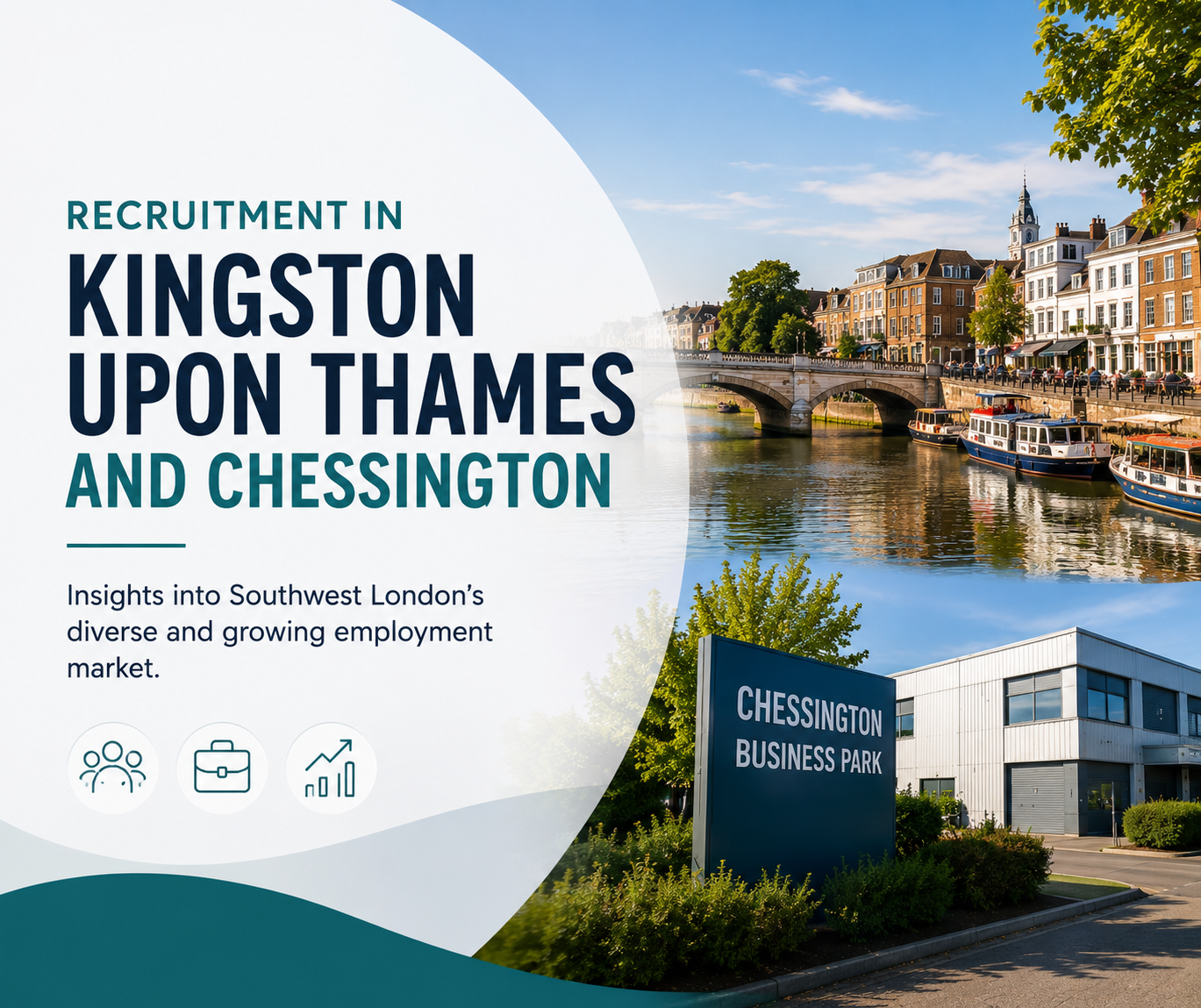
Recruitment in Kingston upon Thames and Chessington
Kingston upon Thames and Chessington sit within the Royal Borough of Kingston upon Thames, forming one of Southwest London’s most diverse employment areas. Positioned between Central London and Surrey, the area supports a broad mix of professional, commercial and operational roles, creating a recruitment market that is both varied and highly competitive.
The borough has an employment rate of approximately 80.1% for working-age residents (ages 16–64), according to the Office for National Statistics. This places Kingston above the wider London average of 74.6%, highlighting the strength of the local labour market. The wider Southwest London economy continues to show strong participation in professional and knowledge-based industries, with growing demand across business support, finance, operations and customer-focused roles. For employers, this creates a recruitment environment that is opportunity-rich, but increasingly shaped by candidate expectations around flexibility, progression and stability.
A Southwest London economy shaped by professional services and business support
Kingston upon Thames is one of the largest metropolitan town centres in London and is widely recognised for its strong professional and service-based economy. Alongside a well-established commercial presence, the area supports a wide range of office-based employers across financial services, consultancies, public sector organisations and corporate environments.
This creates consistent demand for roles across administration, customer service, operations support, HR, finance and marketing, with many businesses seeking candidates who can operate across multiple functions in fast-paced environments. The presence of both large organisations and SMEs contributes to a steady flow of opportunities at both entry and mid-level.
Chessington contributes a complementary employment profile, with its economy shaped by a strong industrial and commercial base centred around established business parks and industrial estates. The area supports a wide range of logistics, warehousing, trade and service-based operations, alongside demand for office-based roles that support these functions.
Industrial and commercial employment in Chessington
A significant proportion of employment in Chessington is concentrated around Chessington Industrial Estate and the surrounding business parks, which act as a key hub for SMEs and established operators across logistics, construction supply, automotive services, warehousing, distribution and specialist trade services. The area benefits from excellent access to the A3 and M25, making it a practical base for businesses serving London, Surrey and the wider Southeast.
This has supported steady demand for both operational and office-based roles, including warehouse operatives, drivers, engineers, technicians, administrators, coordinators and operations support staff. Recruitment in this part of the market is typically shaped by practical skill requirements, local availability and the need for responsive staffing solutions to meet ongoing commercial demand.
Education, skills and early-career talent
A major influence on Kingston’s market is Kingston University, which supports a large student population and contributes significantly to the local talent pipeline. National data shows that 87.6% of working-age graduates are in employment, compared to 68.0% of non-graduates, reinforcing the value of higher education in supporting employability and access to skilled roles.
This aligns with Kingston’s highly qualified workforce and creates a reliable pipeline of early-career talent for employers offering structured entry-level roles and development opportunities, particularly across business, operations and professional services functions.
A commuting workforce across Southwest London and Surrey
The Kingston and Chessington market is defined by a highly mobile workforce. A significant proportion of employees commute in from surrounding areas including Richmond, Wimbledon, Sutton, Epsom and parts of Surrey, all of which are well represented within our candidate database.
ONS data shows Kingston has strong commuting links and a workforce that both travels into Central London and attracts inbound workers, contributing to a competitive hiring landscape. Employers are therefore competing not only locally, but also against London-wide salary expectations, hybrid working models and broader Southeast opportunities.
How recruitment patterns are evolving
Recruitment trends in Kingston and Chessington continue to be shaped by three key pressures: competition for skilled talent, rising candidate expectations and sector-specific hiring cycles.
In Kingston, employers are increasingly focused on hybrid working, retention strategies and employer branding to compete with Central London organisations. In Chessington, recruitment is driven by operational demand, with many businesses requiring efficient hiring processes to support both operational delivery and office-based functions.
Across both areas, there is a growing emphasis on flexibility, training pathways and long-term workforce planning, particularly within administration, customer service and operations roles where demand remains consistently high.
Looking ahead for local employers
Kingston and Chessington continue to represent a diverse and resilient employment area within Southwest London. Kingston provides a strong foundation in professional services, education and office-based employment, while Chessington contributes a well-established commercial and operational business base.
For employers, success in this market depends on understanding the complementary nature of the borough: Kingston as a competitive professional and office-based hub, and Chessington as a commercially driven centre supporting both operational and business support functions.
Businesses that align their recruitment strategies with these local dynamics, while leveraging education pipelines and flexible workforce models, are best positioned to remain competitive in an evolving market.